No products in the cart.
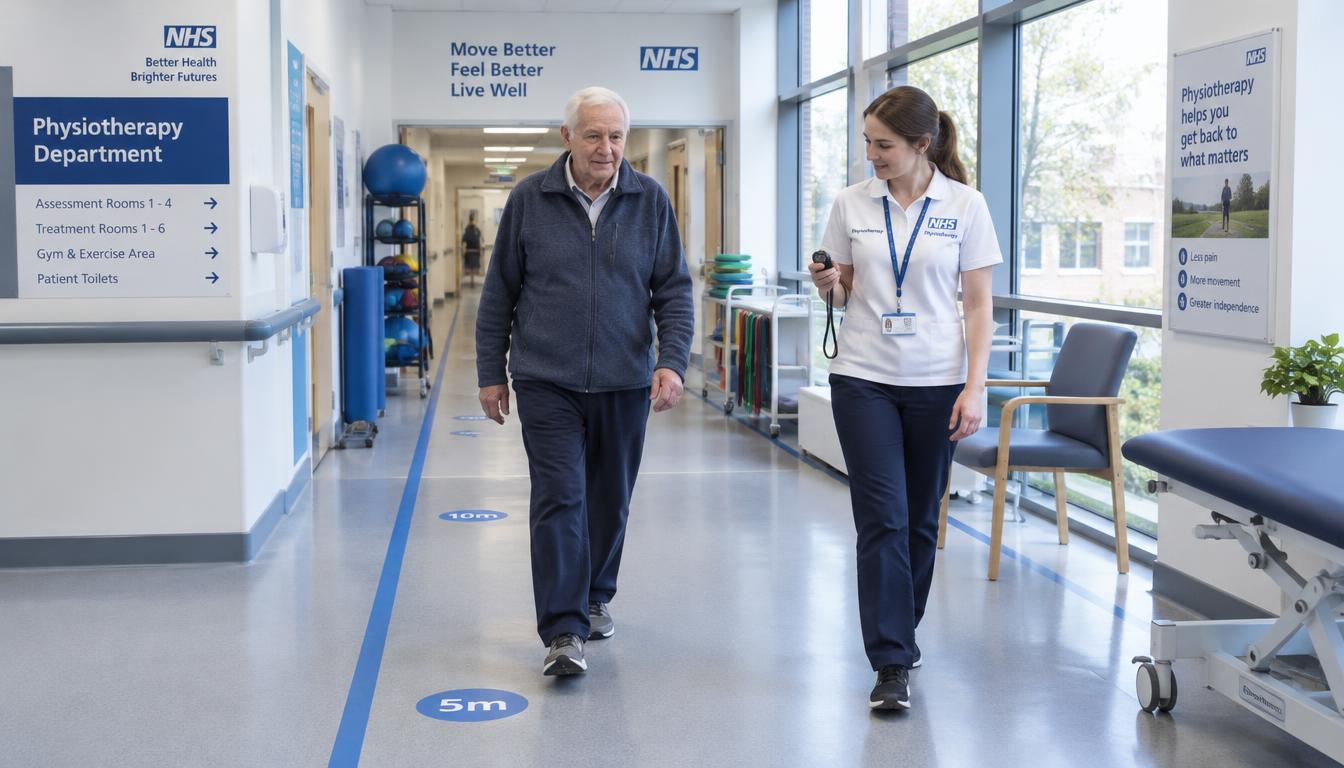

The 10-Metre Walk Test, often called the 10MWT, measures how quickly a person walks in a straight line over a level surface. It focuses on walking speed rather than endurance or complex manoeuvres. The course is set up under controlled conditions so the clinician can record the time taken over the measured distance.
Gait speed, also known as gait velocity, is calculated by dividing the distance walked by the time taken. The result is expressed in metres per second. For example, the same distance completed in less time gives a higher walking speed. In clinical practice, gait speed reflects the combined contribution of the nervous, muscular and skeletal systems. Changes in illness, injury, muscle activation or balance can affect the way a person walks and the result recorded.
Clinicians often measure walking speed at two different paces. Comfortable walking speed is the person’s usual, self-selected pace. Maximum walking speed is the fastest pace they can manage safely. Comparing these results gives information about both everyday walking and the additional capacity available when a person needs to move more quickly, such as when crossing a road.
Walking velocity is one indicator of physical functioning. It brings together aspects of balance, muscle strength and cardiovascular coordination in a single measurement, but should be interpreted alongside the person’s wider clinical picture.
The 10-Metre Walk Test is a straightforward walking test that requires little equipment. A clinician needs a stopwatch, clearly measured floor markings and an unobstructed pathway. These basics make the assessment suitable for hospital wards, outpatient physiotherapy gyms and community clinics. As an outcome measure, it provides a record of walking speed that can be reviewed alongside other physical performance measures.
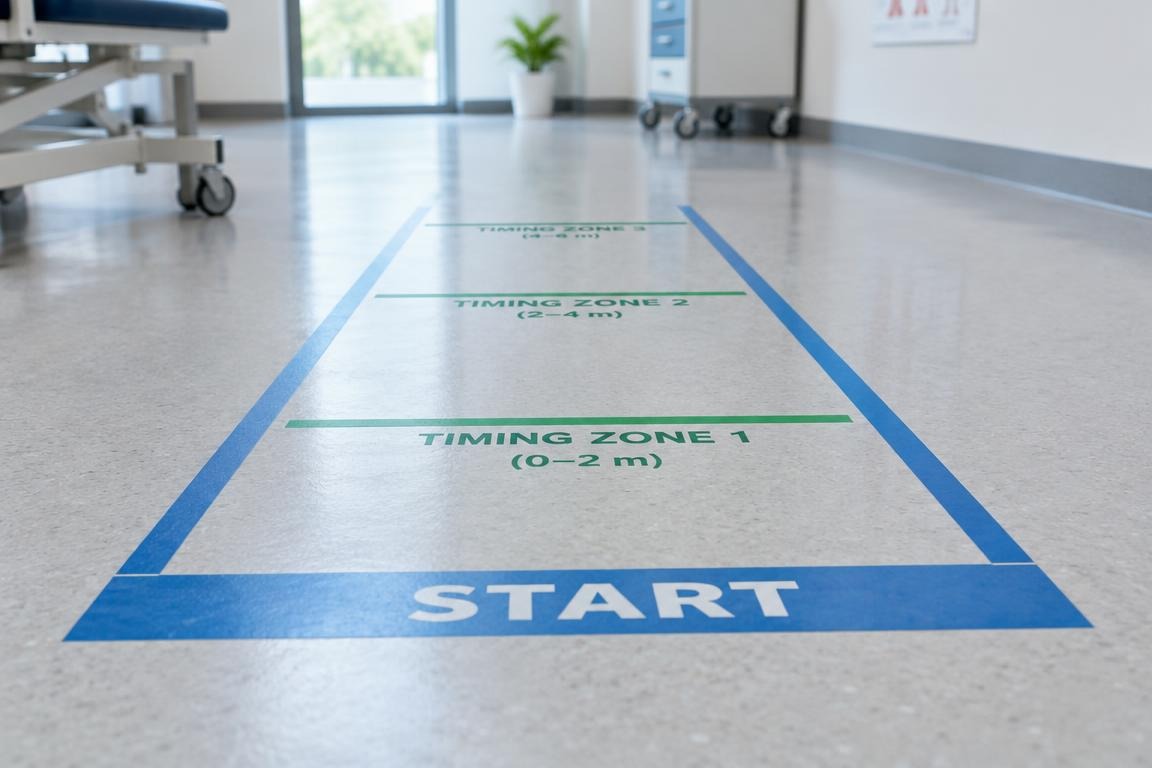
Accurate floor markings define the timing boundaries during a standard gait velocity assessment.
Walking speed gives healthcare professionals an objective indication of functional capacity and general health. Regular assessment can reveal changes that may not be clear from observation alone. In physical therapy, recording a baseline gait speed helps clinicians set relevant goals and review how a person responds to rehabilitation.
Changes in gait speed can accompany changes in everyday mobility, including how much support a person needs from caregivers and their confidence with daily tasks. This is relevant across different groups, including older adults. However, a faster result does not by itself prove that a person has become more independent. Clinicians interpret walking speed alongside the individual’s health, daily function and other physical performance measures.
Repeated measurements also help clinicians consider whether a change is meaningful or within normal day-to-day variation. Test-retest reliability describes how consistently a measure produces results when testing conditions are repeated. The minimal detectable change is another consideration: it helps distinguish a change that is likely to be greater than measurement variation from a small difference in the recorded score. These concepts support careful interpretation of outcome measures; a systematic review may also be relevant when considering the evidence for a particular measure.
Comfortable walking speed measures a person’s usual, self-selected pace. It gives clinicians information about customary mobility at home and in the immediate community. For older adults, as for other people in rehabilitation, this result is considered in the context of their usual activities and needs.
Fast walking speed assesses how well a person can safely increase their pace when needed. It offers information about available motor control and dynamic balance during greater physical demand. Comparing this result with comfortable walking speed helps clinicians understand the difference between usual pace and faster walking.
Documenting both measures supports communication between physiotherapists, occupational therapists and medical consultants. Recorded changes in metres per second provide quantifiable information to guide rehabilitation decisions, while clinical judgement determines whether the change is meaningful for that person. These results are one part of assessment, not a substitute for considering broader function and individual goals.
A consistent procedure helps produce dependable results when administering the 10-metre walk test. Clinical protocols vary, so the method selected should be documented and kept the same for each person across sessions. This consistency supports test-retest reliability and makes it easier to interpret changes in walking speed.
Many protocols include acceleration and deceleration zones outside the timed section. In a common 14-metre layout, the person walks two metres before the timing area, covers a central ten-metre course while being timed, then continues for two metres beyond the finish line. This arrangement gives the person space to reach and maintain a steady pace before entering the timed section.
The extra zones help limit the effect of starting and slowing down on the recorded gait speed. If timing begins as the person sets off from a standstill, the first steps include acceleration rather than reflecting a steady walking pace. The exact layout and timing method should follow the clinic’s chosen protocol.
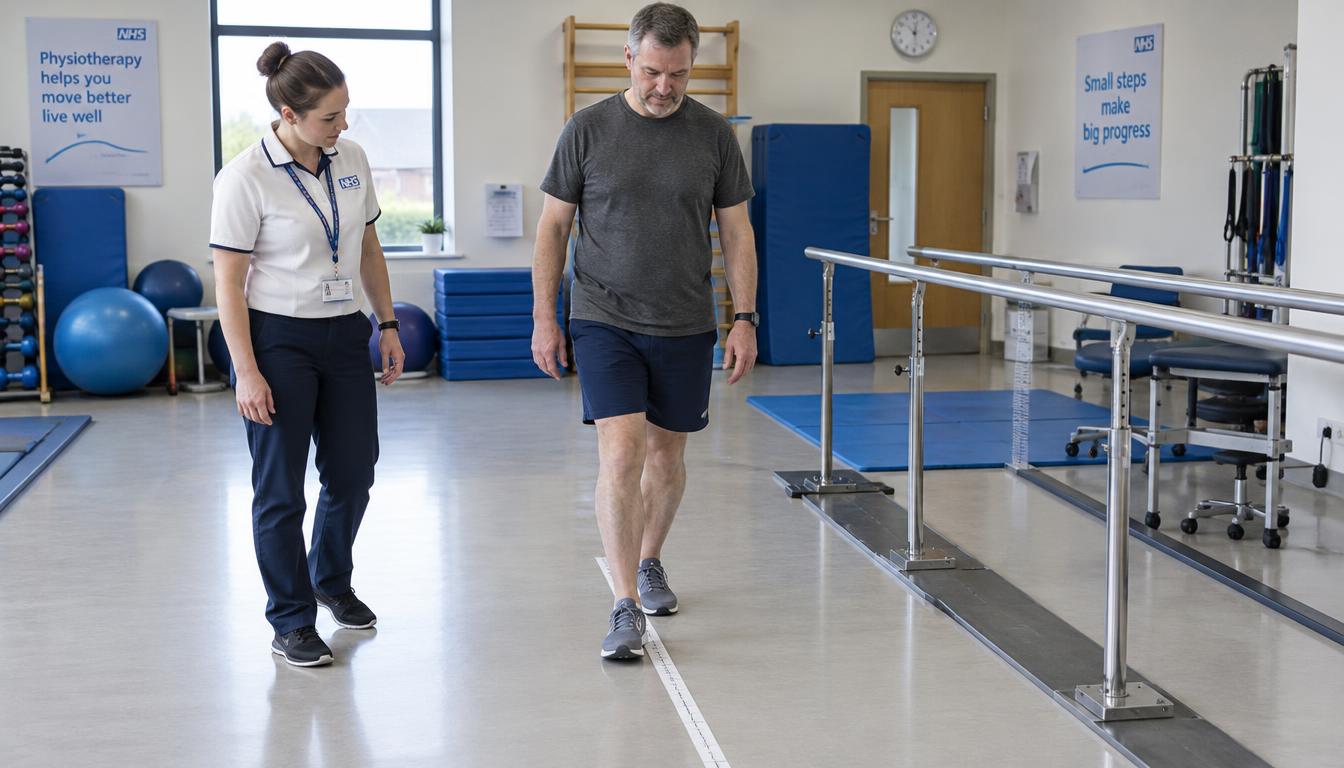
Consistent positioning alongside the walking course allows the therapist to maintain patient safety while recording accurate times.
Where space is limited, some clinics use a ten-metre total course and start timing from the person’s first movement. This static-start approach differs from a flying start, where the person is already walking before entering the timed section. The source protocol reports slightly lower average speeds with static starts, so the method used should be recorded and kept consistent. Reliable comparisons depend on consistent administration; test-retest reliability and the interpretation of any minimal detectable change are considered in relation to the protocol used.
People who use a mobility aid should complete the assessment with their usual device, so the result reflects their functional walking. This applies to people receiving physical therapy after spinal cord injury, as well as to others who rely on walking support. Sticks, elbow crutches, walking frames and rollators are suitable, provided the device used is recorded.
Keep orthoses, such as ankle-foot orthoses or knee braces, consistent between sessions. Changing equipment after a spinal cord injury assessment, or during assessment for another condition, introduces differences that can make changes in physical ability harder to interpret.
Record any assistance provided by the therapist alongside the time. If a person needs contact guarding or hands-on support for stability, the result describes assisted walking, not independent mobility. This distinction is important when monitoring recovery from cord injury.
Record the specific mobility aid, orthotic support and level of physical assistance used. Results from a session with a walking frame should not be compared directly with a session completed independently. For people with cord injury, as for anyone else, consistent equipment and support help make repeat assessments more meaningful.
Safety remains the priority throughout the assessment. The therapist stands slightly behind and to the side, ready to support the person if they become unsteady, without setting the pace or interfering with their natural movement.
To calculate gait speed, divide the timed distance in metres by the time recorded in seconds. For example, walking six metres in six seconds gives a speed of 1 m/s. This calculation applies to the timed section of the walk test, using the distance specified in the chosen protocol.
Rehabilitation research often groups walking speeds into broad functional categories. These ranges are useful benchmarks, not fixed rules. Clinicians consider them alongside a person’s health, balance and usual environment. A walking speed alone does not determine whether someone can manage a particular journey or cross a road safely.
| Functional Category | Velocity Range | Typical Mobility Context |
| Household | Under 0.4 m/s | Movement primarily restricted to familiar indoor spaces with assistance |
| Limited Community | 0.4 to 0.8 m/s | Able to manage level outdoor surfaces and short community trips |
| Community | Above 0.8 m/s | Sufficient speed to cross light-controlled pedestrian crossings safely |
A speed below 0.4 m/s is often associated with functional ambulation mainly within the home. The 0.4 to 0.8 m/s range is commonly described as limited community mobility. People in this range may manage level outdoor paths and short trips, while kerbs and uneven pavements can place greater demands on balance and stamina. A speed above 0.8 m/s is associated with community mobility, but does not by itself confirm that a person can cross pedestrian signals safely within standard light cycles. The 0.8 m/s community threshold is a general guide, not an individual safety assessment.
When reviewing repeated walk test results, clinicians also consider whether a difference represents meaningful change or normal variation. Test-retest reliability describes consistency across repeated assessments. The minimal detectable change helps assess whether a recorded difference is likely to exceed measurement variation; it does not establish that the change is important to the individual. Interpretation of detectable change depends on the protocol and the person being assessed. For guidance on mobility measures, individuals may find a physiotherapist through professional registers for a clinical review.
Individual gait analysis requires careful observation of posture, stepping symmetry, and cardiovascular response alongside numerical timing.
A walking-speed result reflects performance at a particular time. It is influenced by personal and environmental factors, so clinicians consider these when reviewing progress. A change between sessions does not always indicate a lasting change in ability.
Fatigue can affect walking pattern and pace, especially during recovery from a neurological condition. For example, a person tested after strenuous exercise or late in the day may record a different result from one obtained when they are rested. Pain, joint stiffness and changes in footwear can also affect stepping rhythm and stride length. Supportive walking shoes provide a different walking experience from loose slippers or hospital socks.
Good test-retest reliability depends on keeping the test track, timing method, verbal instructions and the person’s resting state as consistent as possible between reviews. Standardisation improves the value of comparisons, but does not remove every source of variation.
Anxiety, concentration and unfamiliar surroundings can also influence how someone walks. A person who feels unsettled in a clinic or has difficulty following complex instructions may walk more cautiously than they would at home. Clinicians should take these circumstances into account when interpreting the result and deciding whether a difference is likely to reflect a genuine change.
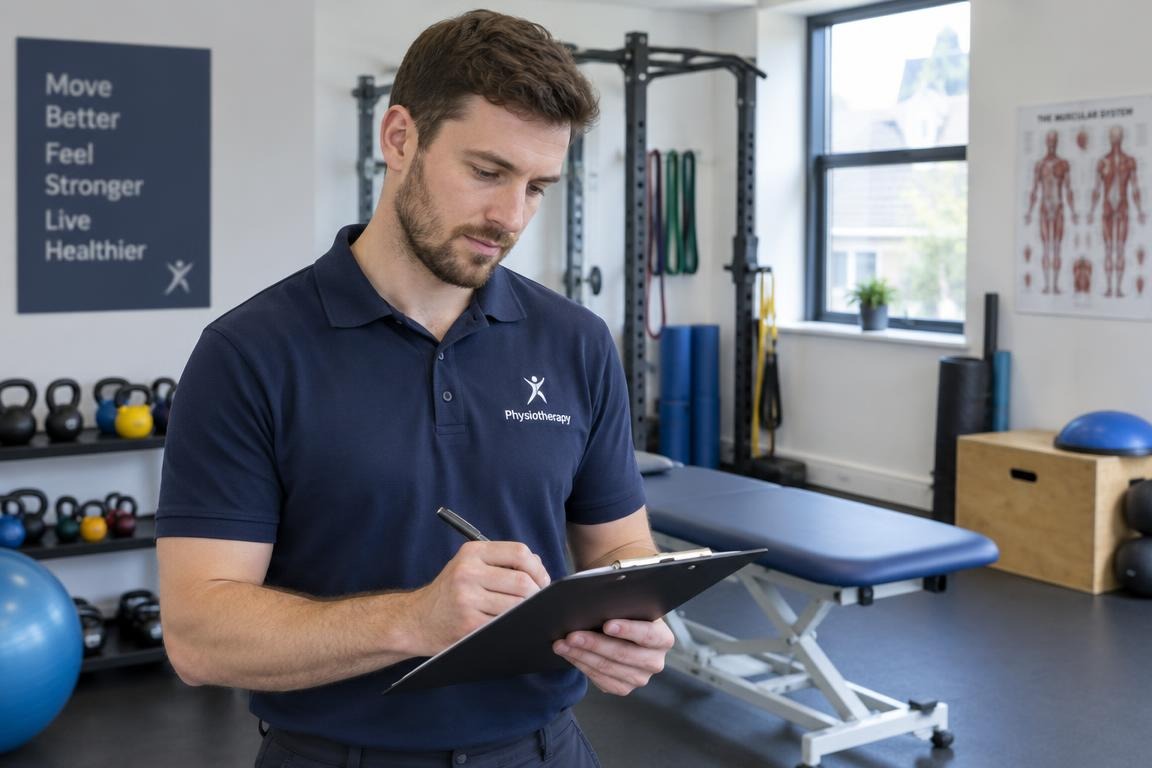
Recording footwear, time of day, and environmental conditions helps ensure reliable comparisons across future therapy reviews.
The 10-Metre Walk Test is used in neurological rehabilitation to record walking speed and monitor changes over time. Clinicians use it when supporting people with spinal cord injury, traumatic brain injury, multiple sclerosis and Parkinson disease. As an outcome measure, it offers a consistent way to document walking performance, while the results are interpreted alongside each person’s wider rehabilitation needs.
After neurological trauma, changes in spasticity, motor coordination and sensory feedback can affect stepping. A standardised assessment records gait speed, helping the team review how changes in movement relate to functional walking. This can be relevant in spinal cord injury and traumatic brain injury, as well as in progressive conditions such as Parkinson disease and multiple sclerosis. The walk test does not explain the cause of a change on its own; clinicians consider it with other assessment findings.
In stroke rehabilitation, repeated assessments help the team review progress and consider whether a change in walking speed is meaningful for the individual. These findings can inform discharge planning and community reintegration, alongside other aspects of care. The same principle applies when monitoring recovery after spinal cord injury or brain injury: a recorded result provides information for discussion, rather than determining a plan by itself. Approaches used in
Tracking gait speeds across rehabilitation sessions helps the healthcare team review whether interventions such as gait re-education or muscle strengthening are associated with measurable changes in daily function. This monitoring can support physical therapy planning after spinal cord injury, traumatic brain injury or stroke, and in conditions such as Parkinson disease and multiple sclerosis. Results are considered in context and alongside other clinical information; no single walking speed establishes a person’s overall recovery or community mobility.
The 10MWT measures straight-line walking speed, but everyday mobility involves other skills too. This walk test does not assess turning, changing direction, standing up from a chair or walking while completing another task. It therefore provides a focused result rather than a complete picture of mobility.
Physiotherapists combine walking-speed assessments with other physical performance measures to understand a person’s abilities more fully. These may include balance tests, such as the Berg Balance Scale, alongside short-distance walking assessments. The Berg Balance Scale provides information about balance; it does not measure gait speed. Together, these outcome measures help clinicians consider different aspects of function. A systematic review or clinical guideline can provide further evidence on how these measures are used, but individual results still need to be interpreted in context.
Clinicians may also compare straight-line walking speed with the Timed Up and Go Test. This assessment records the time taken to stand from a chair, walk three metres, turn and sit down again. Considering both tests helps identify whether a person walks at a suitable pace in a straight line but finds turning or moving between positions more difficult.
The Berg Balance Scale and walking tests offer complementary information, rather than interchangeable results. Choosing appropriate physical performance measures helps therapy teams consider both walking capacity and the balance and agility needed for everyday activities. The 10-Metre Walk Test is one part of this wider assessment, and its findings should be considered alongside other clinical information and the person’s goals.
The 10-Metre Walk Test is a standardised clinical assessment of how quickly someone walks a short, straight distance. Physiotherapists use this walk test to assess mobility, monitor recovery and calculate gait speed in metres per second.
It measures walking speed over a level surface at a comfortable or maximum safe pace. The result provides information about functional walking ability and is considered alongside other clinical findings.
The individual walks along a measured, straight course while a clinician uses a stopwatch to time the designated section. Some protocols include space before and after it for acceleration and deceleration.
Walking speed offers an objective measure of walking performance. Tracking it over time helps clinicians review changes during rehabilitation and consider them alongside everyday function and mobility goals.
Yes. A person may use their usual walking stick, frame or rollator. The clinician records the device and any orthoses used, so these can be kept consistent in future assessments.
Divide the timed distance in metres by the time in seconds. Walking six metres in five seconds gives a gait speed of 1.2 metres per second.
Fatigue, pain, muscle weakness, footwear, confidence and the testing environment can all influence a person’s pace. Clinicians consider these factors when interpreting results.
Yes. Clinicians use this walking test during stroke rehabilitation to monitor walking and functional progress. Results help inform mobility goals and discharge planning alongside other assessments.
The 10-Metre Walk Test measures straight-line walking speed. The Timed Up and Go Test also assesses standing from a chair, walking three metres, turning and sitting down.
Walking speed can improve as strength, balance and confidence change during rehabilitation. Physical therapy and consistent practice support progress, which clinicians review in the context of each person’s needs.
The 10-Metre Walk Test provides an objective measure of walking speed to support mobility assessment in clinical and community settings. Consistent test conditions and clear records of assistive equipment help clinicians compare results over time. Considered alongside balance assessments and the person’s wider clinical picture, the findings can inform tailored rehabilitation and support safe independence.

Book a personalised demonstration of the StandSure™ today by filling out our request form. Have any questions? Call us now, and our team will be happy to assist!


