No products in the cart.
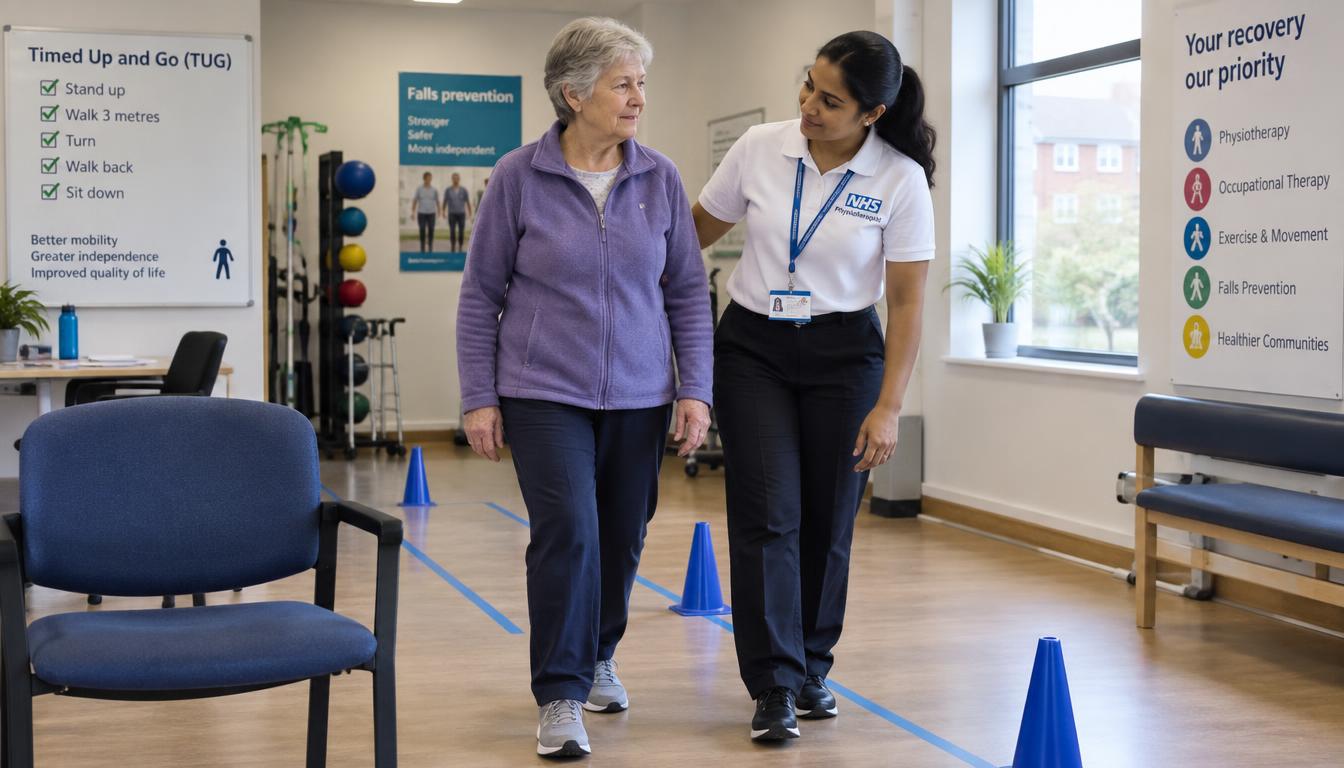

A supervised assessment can show where mobility becomes difficult and which part of the movement may need closer attention.
The leading pages serve a mixed audience. Some readers want a definition for study or clinical revision. Others need to perform the test correctly, interpret a score or decide whether further rehabilitation is appropriate.
These pages build trust through definitions, procedures, research references and cautious interpretation. Their conversion goal is usually indirect. The reader is encouraged to explore more education rather than buy immediately.
These articles answer the clinical question while connecting the topic with practice management. The reader may be invited to request a demonstration, start a trial or enquire about a service.
These pages commonly use the topic to introduce training, courses or continuing professional development. The article provides value before presenting registration or learning options.
The strongest route is educational first, practical second and commercial only when the reader has enough context. This supports search intent and avoids interrupting the clinical explanation.
Download a concise TUG documentation checklist for recording the chair, distance, walking aid, time, observations and safety notes.
The Timed Up and Go, often shortened to the TUG test, is a timed assessment of functional mobility. It begins with the patient seated in a chair. The patient stands, walks to a marked point, turns, walks back and sits down.
The commonly used walking distance is 3 metres. Protocols can vary, so the distance, chair height, footwear, walking aid and instructions should be documented.
The timed result is useful because it summarises several movement demands in one short task. It should still be considered alongside history, examination and the person’s usual activity.
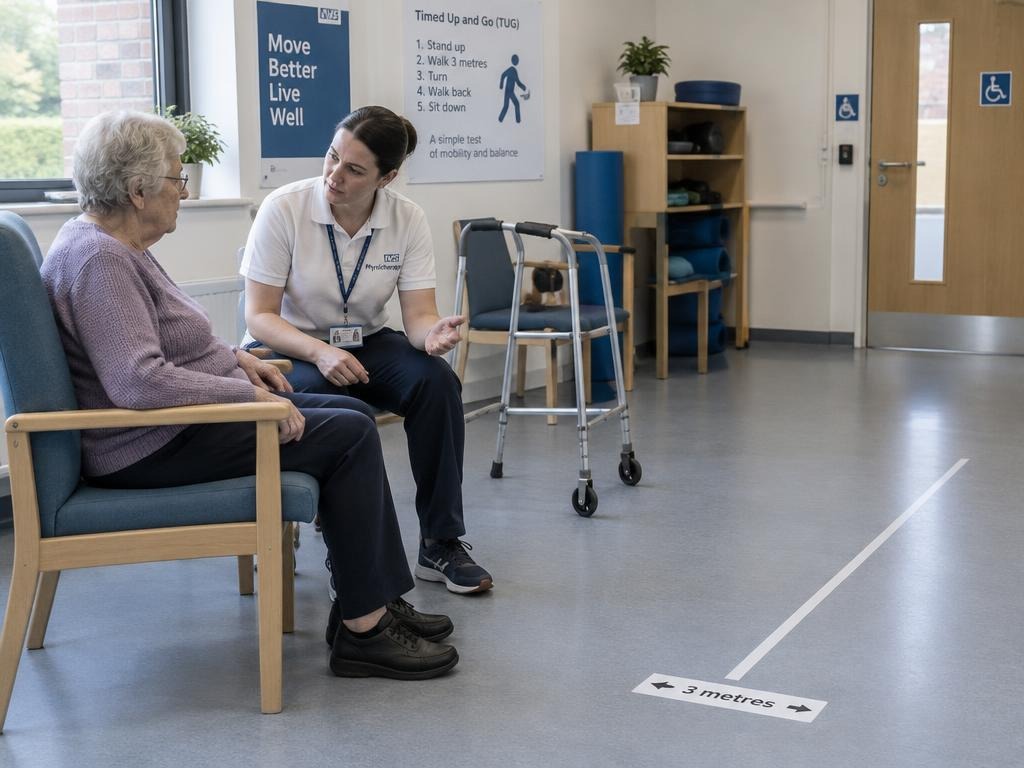
The TUG test is quick, inexpensive and easy to repeat. It can be included in a physiotherapy assessment, rehabilitation assessment, balance assessment, walking assessment or falls risk assessment.
Older adults may be referred for a TUG because of a fall, reduced confidence, slower walking, a neurological condition or a change in daily function. It may also be used with people after stroke, with Parkinson disease or during general rehabilitation.
The test does not replace a full clinical examination. A patient may complete the task quickly yet still have unsafe judgement, poor endurance or difficulty managing stairs. Another patient may take longer because of pain but remain safe and independent in familiar surroundings.
The TUG test measures the time needed to complete a linked sequence of movements. It is not a pure measure of walking speed. The result includes chair transfer, balance, gait, turning and sitting control.
Standing from a chair requires force from the lower limbs, trunk control and coordination. Arm use may change the task. A low chair can increase the challenge, while armrests may provide support.
The walking section gives information about pace and rhythm. Clinicians may also observe step length, foot clearance, asymmetry, hesitation and the need for verbal prompts.
Turning can expose problems that are not obvious during straight-line walking. A patient may slow down, take several small steps, reach for support or lose alignment.
The final return to the chair shows how well the patient controls the body while approaching a target and lowering into the seat. Rushing or misjudging the chair may increase risk.
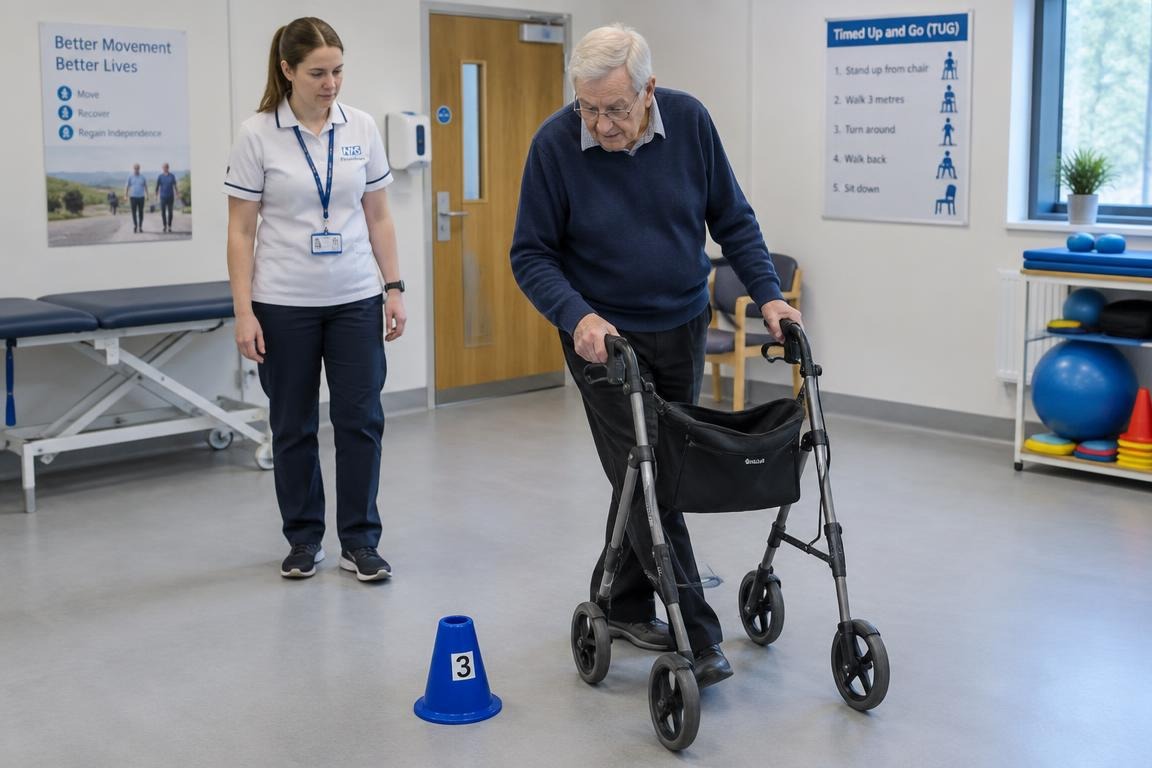
Only a small amount of equipment is required, but the setup matters. A stable chair, a clear walking path, a visible marker and a reliable timer are usually sufficient.
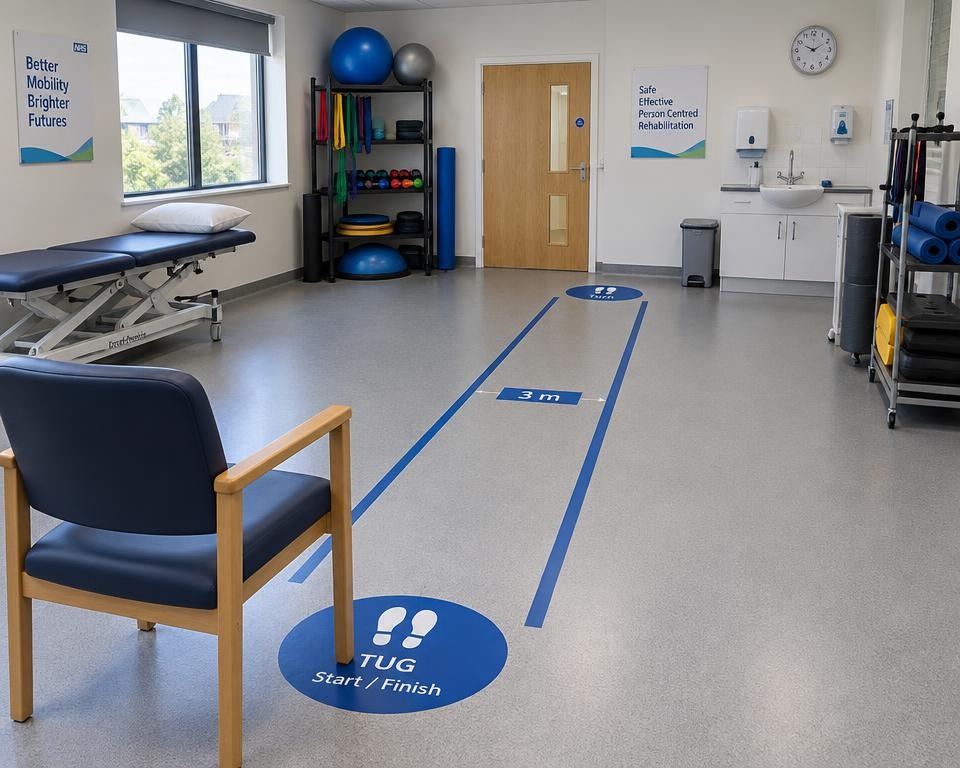
Lighting, noise and space can affect confidence. A familiar environment may produce a different result from a busy ward or unfamiliar clinic. These conditions should be recorded when they are likely to influence performance.
The test should be explained in plain language before timing begins. The patient should know the route and understand that safety takes priority over speed.
A consistent instruction may be used: “On go, stand up, walk to the marker, turn, walk back and sit down.” The patient should move at a safe, comfortable pace. They should not be encouraged to rush.
A practice trial can help the patient understand the route. If one is used, record it clearly. A practice trial may reduce hesitation, but repeated attempts can also introduce fatigue or learning effects.
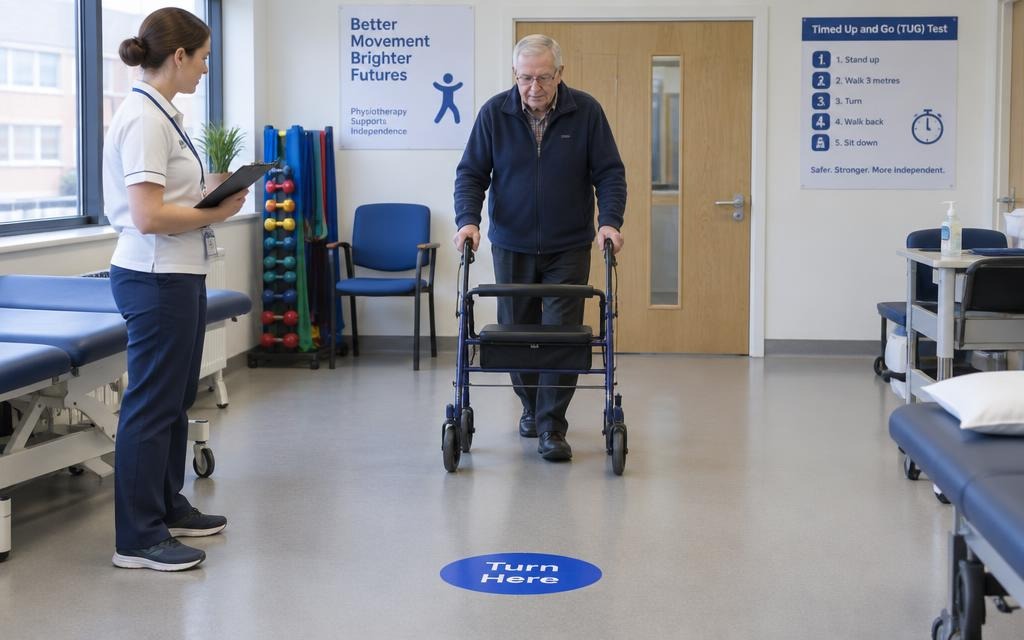
Use a structured checklist to record the time, walking aid, chair type, turning pattern, balance observations and patient-reported confidence.
A walking aid may be used when it is part of the patient’s usual mobility. The aim is to observe functional mobility in a safe and representative way, not to remove a device that the patient normally needs.
Safety takes priority. A patient with marked difficulty standing, difficulty walking, dizziness, severe pain or a high fall risk should not be asked to complete an unsupervised timed test.
Stop the test if the patient becomes unsteady, distressed, breathless, dizzy, confused or unable to continue safely. The time is less important than preventing harm.
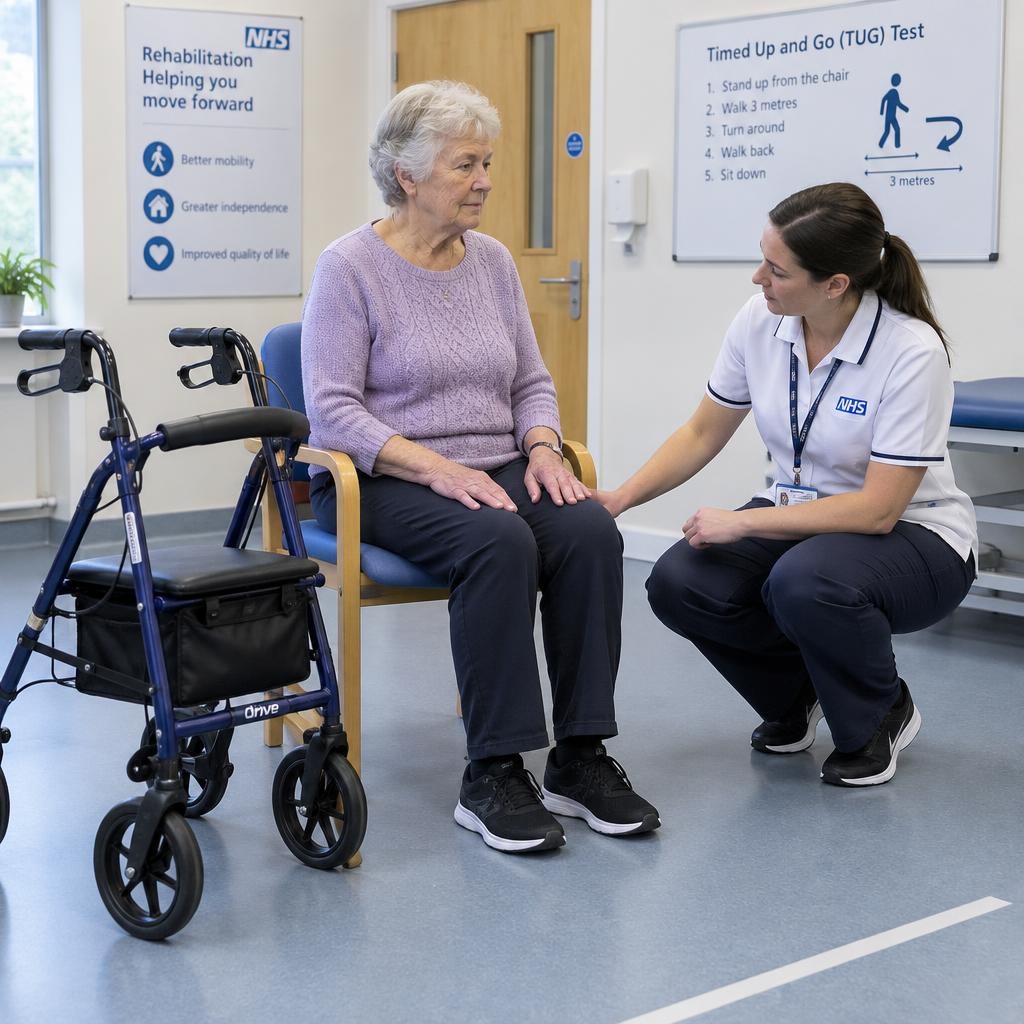
The result is recorded in seconds. A shorter time often suggests more efficient functional mobility, while a longer time may indicate that further assessment is appropriate.
There is no single result that diagnoses a condition or predicts a fall with certainty. Published thresholds can differ by age, health status, diagnosis, protocol and setting. A score used with community-dwelling older adults may not have the same meaning in a hospital ward, neurological clinic or care home.
| Finding | Possible clinical meaning | What to consider next |
| Longer time than expected for the person | Reduced efficiency, weakness, pain, balance difficulty or low confidence may be present. | Review gait, strength, transfers, symptoms, cognition and usual activity. |
| Large difference between trials | Learning, fatigue, attention, anxiety or inconsistent instructions may have affected performance. | Check the protocol and repeat only when clinically appropriate. |
| Slow turning or hesitation | Dynamic balance, postural control or neurological factors may need review. | Observe turning in more detail and consider a wider balance assessment. |
| Difficulty lowering into the chair | Reduced control, lower limb weakness, pain or poor judgement may be contributing. | Assess the chair transfer and safety during everyday sitting. |
Research may report a threshold linked with increased fall risk, but the threshold is not universal. The choice of chair, distance, instructions, walking aid and timing method can change the result.
Clinical reasoning should therefore include the person’s baseline, change over time, history of falls, confidence, home environment and ability to manage daily tasks.
A timed test is influenced by more than leg strength. The result reflects the person and the testing conditions at that moment.
Age also affects performance, but age alone should not determine the interpretation. A result should be compared with suitable evidence and the person’s own functional status.

The TUG can contribute to a falls risk assessment, but it is not a complete fall risk assessment by itself. A slower time may indicate that further review is sensible, especially when combined with a history of falls or observed instability.
Community-dwelling older adults may have different risks from people recovering in hospital. A person with Parkinson disease may have freezing or turning difficulty that is not fully reflected by the total time. Someone after stroke may have asymmetry that requires separate gait assessment.
The result should support a conversation, not create alarm. A trained clinician can decide whether rehabilitation, equipment advice, home assessment or referral is suitable.
Request a supervised mobility assessment to review transfers, gait, turning, walking aid use and practical safety goals.
The test can be useful across several settings, but its interpretation should reflect the population being assessed.
For older adults, the TUG may help identify a change in functional mobility. It can be repeated during rehabilitation, provided the conditions are similar and the patient is medically appropriate for testing.
In community-dwelling older adults, the test may be considered alongside outdoor walking, stairs, transfers and confidence. A clinic result may not show how the person manages uneven pavements, public transport or busy environments.
People with Parkinson disease may show hesitation, freezing, reduced stride length or difficulty turning. Medication timing, fatigue and the patient’s “on” or “off” state may affect the result and should be documented.
After stroke, a TUG result may reflect weakness, asymmetry, reduced balance or reduced confidence. A wider assessment can examine the quality of movement rather than relying on time alone.
In care homes, the TUG may form part of a broader mobility review. Staff should use consistent instructions and ensure the environment is safe. Changes in function should be shared with the relevant clinical team.
Research commonly supports the TUG as a practical measure of functional mobility. Reliability can be good when the procedure is standardised and the person’s condition is stable.
The TUG may have a ceiling effect in highly mobile patients. It may also be affected by learning, anxiety or unfamiliarity. A single result does not explain why mobility is reduced.
Research findings may not apply equally to every group. The most appropriate evidence depends on age, diagnosis, setting, protocol and outcome being considered.
Use the score as one part of a wider assessment. Combine it with patient history, observed movement, functional goals and professional judgement.
Good documentation makes a timed test useful to the wider care team. A score without context is difficult to interpret or reproduce.
| Record | Example information |
| Date and setting | Outpatient clinic, care home, ward or home visit. |
| Chair | Height, armrests, back support and stability. |
| Distance | Protocol distance and turning point. |
| Time | Result in seconds and whether it was a first or repeat trial. |
| Walking aid | None, stick, frame, rollator or other device. |
| Assistance | Independent, supervision, verbal prompt or physical assistance. |
| Observations | Pain, hesitation, turning pattern, balance, fatigue and chair control. |
Record the patient’s own concerns where possible. A patient may report that the test felt harder than usual, even when the time changes only slightly.
The TUG can help a rehabilitation team choose meaningful goals. The goal should relate to daily function, not only to achieving a faster number.
Practise standing from a chair, controlling the descent and completing a safe chair transfer.
Work on gait speed, step length, turning and dynamic balance in a graded environment.
Link the assessment to tasks such as getting up at night, reaching the toilet or moving around the home.
A faster result is not always the only desirable outcome. Safer movement, improved confidence and greater functional independence may matter more than a small reduction in seconds.
Speak with a rehabilitation specialist about assessment, walking aid selection and practical mobility support for clinical or care settings.
Professional advice may be appropriate when mobility has changed, falls have occurred or everyday movement has become less confident.
Urgent medical advice may be needed for sudden weakness, new confusion, chest pain, severe breathlessness or a sudden inability to walk. A routine TUG test should not delay urgent care.
The Timed Up and Go Test is a short mobility assessment. The patient stands from a chair, walks to a marker, turns, walks back and sits down. The time and movement quality are recorded.
It measures functional mobility across several tasks, including sit to stand, walking speed, turning, dynamic balance, postural control and sitting down safely.
The patient begins seated in a stable chair. On instruction, the patient stands, walks to a marked point, turns, walks back and returns to the chair. The clinician records the time and observations.
A commonly used distance is 3 metres. Protocols can vary, so the distance and testing conditions should be documented.
Yes. A patient may use their usual walking aid when appropriate. The type of aid, level of assistance and any safety concerns should be recorded.
It includes balance demands, especially during standing, walking, turning and sitting. It is not a complete balance assessment and should be interpreted with other findings.
It can contribute to a falls risk assessment, but it is not a perfect predictor of falls. Fall history, gait, strength, cognition, medication and the home environment also matter.
Possible factors include pain, weakness, reduced balance, fatigue, fear, neurological disease, slower gait, cognitive changes, a walking aid or an unfamiliar testing environment.
The most useful interpretation combines the timed result with how the patient moved, what the patient felt and how movement relates to daily life.
The Timed Up and Go Test is a practical way to observe functional mobility. It brings together standing from a chair, walking, turning, dynamic balance and sitting control in one short assessment.
A result in seconds can support clinical reasoning, but it should never stand alone. Age, strength, pain, balance, walking aids, neurological conditions, fatigue, cognition, confidence and testing conditions all influence performance.
Used safely and interpreted in context, the TUG can help clinicians identify mobility problems, plan rehabilitation and support functional independence. When concerns remain, a supervised physiotherapy or rehabilitation assessment is the safest next step.

Book a personalised demonstration of the StandSure™ today by filling out our request form. Have any questions? Call us now, and our team will be happy to assist!


