No products in the cart.
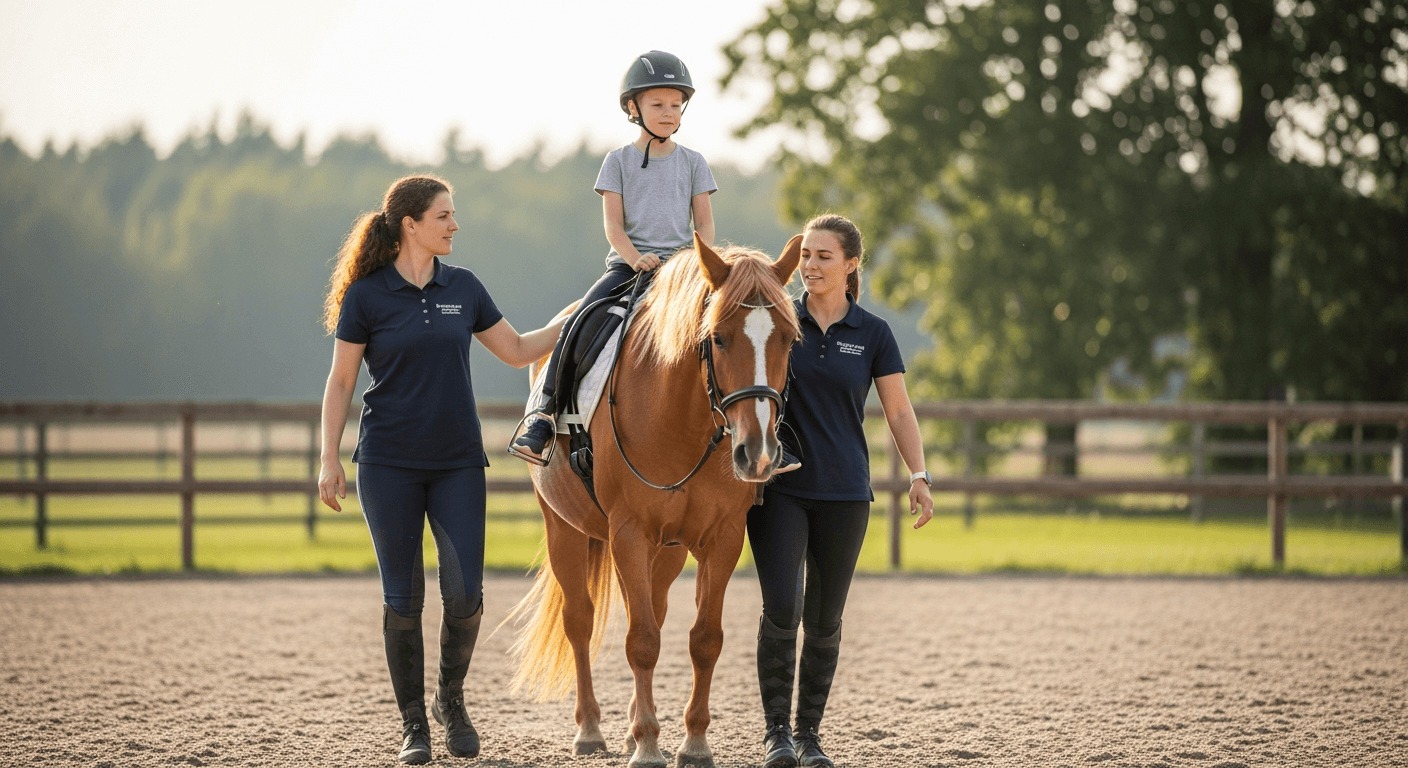

Hippotherapy (from the Greek hippos, meaning horse) is a therapist-directed clinical intervention that uses the three-dimensional movement of a horse to provide controlled sensory and motor input. Delivered by licensed healthcare professionals—commonly physiotherapists, occupational therapists or speech and language therapists with specialised training—hippotherapy is distinct from recreational horseback riding and equine-assisted activities because it is applied as a purposeful treatment modality.
In clinical practice the horse functions as a dynamic treatment surface. The rider does not direct the animal; instead, the therapist positions the patient and adapts the activity to meet specific rehabilitation goals. The horse’s movement produces a repetitive, gait-like stimulus that can be harnessed to address posture, core control, muscle tone and functional movement patterns.
Typical sessions are bespoke to the patient’s needs and often last around 30 minutes, providing a high volume of neuromotor and sensory input. Exact counts such as “2,500 inputs” are sometimes cited in the literature; check primary sources for precise figures relevant to a given protocol. Evidence summaries and reference links are provided later in this article for clinicians and commissioners.
When walking, a horse generates predictable, rhythmic movements that are transferred to the rider in three planes:
These movement patterns approximate human pelvic motion during gait. For patients with mobility impairment, sitting astride a moving horse creates a reproducible gait simulation that stimulates postural reactions and retrains neuromotor pathways—useful when practising balance, weight-shift and coordinated trunk responses.
The horse’s warmth, rhythmic breathing and heartbeat provide additional proprioceptive and calming input. This multisensory environment can reduce muscle spasticity, promote relaxation and improve body awareness—factors that support therapy goals for children and adults with sensory processing differences or heightened anxiety.
Therapists vary patient position (forward-facing, side-sit or prone), adjust the horse’s pace and alter direction to target specific muscle groups or functional tasks. For example, a therapist aiming to improve pelvic stability may use slow, straight-line walking with cueing to the pelvis and trunk, then progress to more complex movement to challenge postural responses.
Mechanical devices—often labelled mechanical horses, hippotherapy simulators or hippotherapy machines—seek to replicate the three-dimensional pelvic motion produced by a live horse. These simulators can offer consistent, repeatable movement and improve access where live horses are impractical. However, simulators do not provide thermal cues, olfactory signals or the adaptive, responsive behaviour of a live animal; the choice between a simulator and a live-horse session should be guided by clinical goals, availability and evidence.
Hippotherapy can assist people across the lifespan who have physical, cognitive or emotional challenges. Clinical studies and systematic reviews indicate benefits for a range of conditions; treatment is goal-focused and tailored to the individual’s needs.

Systematic reviews and clinical trials report promising outcomes for particular groups. For example, research reviewing hippotherapy for children with autism found improvements in social communication, sensory processing and motor skills; separate studies in multiple sclerosis report gains in balance and gait. Where evidence exists, it is often modest in scale and should be considered alongside individual clinical assessment—references and links to evidence summaries are provided later in this article.
“The horse’s movement creates a three-dimensional dynamic that works the core muscles and improves overall strength. It also stimulates sensory systems, promoting confidence and well-being in a non-clinical setting.”


The holistic nature of hippotherapy makes it a valuable adjunct to conventional therapies such as physiotherapy, occupational therapy and speech and language therapy. While some patients reach therapeutic plateaus with conventional approaches, adding hippotherapy has led to clinically meaningful gains for certain individuals; however, outcomes vary and should be reviewed against individual goals and outcome measures.
Not every horse is suitable for therapeutic work; therapy horses undergo careful selection and training to ensure safety, consistency and suitability for patients’ needs. Common selection criteria include:
Within the clinical setting the horse functions as a co‑therapist: the human therapist directs therapeutic aims while the horse provides dynamic, responsive movement. The combination of three‑dimensional movement, warmth and rhythmic cues contributes multisensory input that supports postural control, core activation and motor learning.

Live horses offer adaptive, multisensory experiences that are difficult to reproduce entirely with technology. Their subtle, moment‑to‑moment adjustments and the human–animal interaction can add therapeutic value beyond purely mechanical movement; however, the clinical choice should be evidence‑informed and aligned to treatment goals.
Mechanical horses, often described as hippotherapy simulators or hippotherapy machines, are motorised devices designed to replicate three‑dimensional pelvic motion similar to that produced by a walking horse. They provide consistent, repeatable movement and can improve access to practice or supplement live‑horse programmes where availability, safety or resources are limiting factors.
Pros and cons of simulators:
In practice, simulators and live horses can serve complementary roles. Simulators may be helpful for initial gait simulation, for clinics unable to host live horses, or for additional practice between hippotherapy sessions. Live‑horse sessions remain valuable when the therapeutic plan relies on multisensory input, adaptive movement responses or the psychosocial benefits of working with animals.
Use of horses for therapeutic benefit has historical roots in recreational and therapeutic riding practices; organised therapeutic riding charities emerged in the mid‑20th century and clinical interest increased through the late 20th century as research in neurorehabilitation expanded. Professional accreditation frameworks and specialist training programmes have developed alongside clinical evidence—confirm exact dates and primary sources when citing historical milestones.
Effective hippotherapy often benefits from preparatory interventions that optimise patient readiness. Physiotherapists have found that targeted preparation before mounting the horse can significantly enhance therapeutic outcomes.

The StandSure Therapy Aid has emerged as a valuable tool for pre-hippotherapy preparation. This innovative device helps establish proper foot positioning and postural alignment before the patient mounts the horse, addressing common challenges that might otherwise limit hippotherapy effectiveness.
Clinical observations indicate that a 20-minute session with the StandSure Therapy Aid before hippotherapy can significantly improve outcomes by:
The StandSure Therapy Aid is available in small, medium, and large sizes to accommodate patients of various ages and needs. Used for just 20 minutes prior to hippotherapy, it can significantly improve therapeutic outcomes by preparing the body for optimal response to equine movement.
In the UK, hippotherapy should be delivered by licensed healthcare professionals such as physiotherapists, occupational therapists or speech and language therapists who have completed additional, specialist training in equine‑based clinical practice. Accreditation and specialist course details are administered by professional bodies and recognised training organisations; clinicians should confirm current requirements with the Association of Chartered Physiotherapists in Equine Activities (ACPEA) and relevant registration bodies.
Clinicians seeking to practise hippotherapy usually complete theoretical coursework plus supervised clinical hours under experienced practitioners. Training covers equine movement analysis, safety and welfare, clinical assessment, goal setting and treatment planning. ACPEA and other recognised providers list course options and directories of accredited practitioners—use these resources when searching for qualified professionals or training pathways.
Hippotherapy is not routinely commissioned across the NHS, although individual trusts may fund it in exceptional cases following local assessment or funding requests. Private session costs vary by provider and location; published ranges commonly fall in the region of £60–£120 per session—confirm local pricing when enquiring. Some private insurers may cover hippotherapy when prescribed by an appropriate healthcare professional; policies and eligibility differ between providers.
Hippotherapy can be appropriate for young children (from around two years of age in some services) as well as adolescents and adults. Suitability is determined by individual assessment, clinical goals and safety considerations rather than chronological age alone.
Discussion continues within clinical and commissioning circles about broader NHS provision. While research has demonstrated benefits for certain conditions, commissioners weigh clinical effectiveness, cost‑effectiveness and service capacity. Families and clinicians interested in NHS funding should pursue local pathways (e.g. clinician referral, individual funding requests) and consider charitable support where appropriate.
The Riding for the Disabled Association (RDA) plays a key role in making equine activities accessible to people with disabilities across the UK. Founded in 1969, the RDA has established numerous local groups offering therapeutic riding, carriage driving and related services. Their programmes aim to develop riding skills while promoting confidence, independence and broader wellbeing.
The RDA maintains standards for horse welfare and participant safety and trains volunteers and instructors to support inclusive sessions. For families and clinicians, the RDA can be a valuable local resource for access to equine activities and information about volunteering or fundraising opportunities.
Funding support: many families access hippotherapy through a combination of private payment, charitable grants and fundraising. Local charities (including RDA groups), trusts and family fundraising are commonly used routes to cover session costs or equipment. Clinicians can advise on potential funding sources and multidisciplinary care plans to support applications.

To find a local RDA group, explore services or enquire about volunteering and fundraising, visit their official website. For clinical referrals or to locate accredited hippotherapy practitioners, consult the ACPEA directory and relevant professional bodies.
For those seeking hippotherapy in the UK, the Association of Chartered Physiotherapists in Equine Activities (ACPEA) provides a directory of accredited practitioners. Accredited hippotherapists combine conventional clinical expertise with specialist training in equine‑based treatment to deliver safe, goal‑focused programmes.
For families: discuss hippotherapy with the child’s current therapist, review local RDA groups and consult the ACPEA directory to locate suitable services. For clinicians: consider accredited training and referral pathways; for commissioners: review evidence summaries and local cost–benefit information when considering provision or funding.
Hippotherapy can be a valuable complement to conventional therapy, offering multisensory and movement‑based opportunities to support functional gains. Outcomes vary between individuals; decisions should be collaborative, evidence‑informed and aligned to clear clinical goals such as improved balance, strength and participation.

Book a personalised demonstration of the StandSure™ today by filling out our request form. Have any questions? Call us now, and our team will be happy to assist!


