No products in the cart.


Functional Electrical Stimulation, or FES for short, is one of the few methods in the field of rehabilitative medicine that has been able to properly connect neurological dysfunction with recovered capability. This new method uses controlled electrical impulses to make muscles that have been weakened or paralysed by accidents, diseases, or other neurological issues work again. FES lets people move in ways that would be impossible without it by copying the signals that the brain and nerves send out. This gives them more freedom and improves their lives.
FES is not a new idea, but it has been used in many more ways in the last few decades, from helping people recover from strokes to helping those with spinal cord injuries. It’s a way to help with daily tasks and retrain muscles at the same time. We’ll learn more about FES as we go along. We’ll examine the science behind it, its evolution, its real-life applications, its pros and cons, the types of devices available, and its compatibility with other therapies. We will also discuss recent developments that could impact its future. This long introduction is meant to give a full understanding of FES, with a focus on its ability to change the way healthcare is done now.
Functional electrical stimulation is the use of electrodes on the skin or, in some cases, under the skin to send low-level electrical currents to specific muscles or nerves. These currents make muscles contract, which lets people move deliberately even when their brain connections are broken. Functional electrical stimulation (FES) is different from general electrical muscle stimulation used for fitness or pain relief because it targets behaviours that are similar to everyday tasks such as standing, walking, or grabbing things.
The first step is to use a device that sends electrical pulses through electrodes. These pulses make nerve fibres depolarise, which sends action potentials that make muscles contract. For instance, FES can make the peroneal nerve send signals to lift the foot at the right time in the gait cycle for someone with a foot drop, which is a common problem where the foot drags when walking because the dorsiflexor muscles are weak. This procedure not only helps people get around, but it also keeps them from falling.
Most FES systems can be programmed, which means that doctors and nurses can change things like the intensity, length, and frequency of the pulse to fit each person’s needs. Some advanced models have sensors that can tell when someone is moving and start stimulation right away. This feature makes it easier to understand and use the therapy.
For thousands of years, people have used electrical stimulation for medical purposes. People in ancient civilisations, such as the Egyptians, attempted to use electric fish, like the torpedo ray, to alleviate pain, believing that the shocks possessed therapeutic properties. But the modern basis of FES came about in the 18th and 19th centuries, thanks to pioneers like Luigi Galvani, who showed that electricity could make frog legs contract, which helped us understand bioelectricity.
FES began to emerge as a distinct medical treatment in the mid-20th century. Researchers like W.T. Liberson made early versions of treatments for foot drop in the 1960s. These treatments used heel switches to send electrical signals while the person was walking. In 1967, Moe and Post applied for a patent for a device that would help paralysed limbs move again. This date is when the term “functional electrical stimulation” was first used. Electronics got better in the 1970s and 1980s, which led to more advanced devices, such as those that help paraplegics stand and walk with crutches.
The FDA approved systems like the Parastep in the 1990s. These systems let paraplegics with thoracic-level injuries walk short distances. Since then, FES has made a lot of progress. It now works with robotics, brain-computer interfaces, and wearable gear, making it a common tool in neurorehabilitation centres all over the world. Today, ongoing research builds on a long history of new ideas to make its uses even better.
You need to know how FES works in the body to understand it. Nerves must carry electrical signals from the brain to the muscles for people to move. When this channel is broken, like with a stroke or spinal cord injury, the muscles don’t get any signals, which makes them weak or paralysed.
FES intentionally generates these signals to assist with muscle movement. Electrodes, which are usually sticky pads on the skin, send out balanced positive and negative pulses to keep you safe and protect your tissue. The pulses, which usually happen between 4 and 12 times per second, change the electric potential across the membranes of nerve cells, which starts action potentials. These can go orthodromically (towards the muscle to contract) or antidromically (towards the brain, which could help neuroplasticity and healing).
Some important things to think about are:
Amplitude: This controls how strong the contraction is.
Pulse Width: This tells which nerve fibres to use. Shorter for sensory nerves and longer for motor nerves.
Frequency: Changes the type of contraction (low for twitches, high for long-lasting tetanic contractions).
Advanced FES systems use closed-loop feedback, which means that sensors watch muscle activity or joint position and change the stimulation right away. This makes things more accurate, less tiring, and gives better results. Surface electrodes are common because they don’t hurt, but implanted ones are better for deeper muscles because they require surgery to put in.
 FES is helpful for many problems with the nervous system and the muscles and bones. It can be used for both short-term and long-term care.
One of the main uses is for spinal cord injury (SCI), which FES helps people stand, walk, and pick things up again. For example, cycling ergometers with FES let people who are paralysed pedal, which is good for their heart health and muscle mass. FES focuses on hemiparesis in stroke patients. It helps the upper limbs heal by making the wrist extensors stronger and lowering the risk of shoulder subluxation.
People with multiple sclerosis (MS) and cerebral palsy (CP) who have foot drop can use FES to help. It makes walking faster and lowers the risk of falling. It also helps with bladder and bowel control by stimulating nerves that assist with urination and stopping issues like infections.
FES helps people with high-level SCI breathe better by making the diaphragm muscles work harder and keeps them from getting pressure sores by improving blood flow. It keeps the range of motion and lowers spasticity during orthopaedic recovery, like after surgery for joint contractures.
To get the most functional benefits, FES is usually used in multimodal rehab programs, often with physical therapy.
FES has many benefits that go beyond just making muscles work right away. It can also help your overall physical, mental, and social health.
Using FES on a regular basis makes muscles stronger and more durable, which keeps paralysis from weakening them. It increases blood flow, which lowers the risk of pressure ulcers and deep vein thrombosis, and it also increases bone density to keep people who can’t move from getting osteoporosis.
FES helps the brain change shape, which is called neuroplasticity. This might help people gain back their ability to control their actions over time. It helps people with gait problems by making walking faster, more balanced, and more efficient, which gives them more freedom in their daily lives.
People who can move again say that their confidence goes up and their sadness goes down, which makes them feel less powerless. It makes it easier for people to work, have fun, and spend time with their families, which makes them happier overall.
Over time, FES can save money on healthcare by cutting down on hospital stays and the need for carers or assistive devices.
FES is generally safe when performed correctly, although it may present specific issues. If the pulses are too strong or last too long, the skin around the electrodes may get red or burnt. When you use your muscles too much, they can get tired, which can make you feel sore, like after a workout.
Autonomic dysreflexia in SCI patients, characterised by a sudden increase in blood pressure due to stimulation, along with interactions with pacemakers and other implanted devices, represents significant risks. You shouldn’t use this if you’re pregnant, have epilepsy, have tumours near the stimulation sites, or have very bad heart problems.
If you have surgery on implanted systems, you could get an infection, or the electrodes could move. If motions are forced, spasticity may get worse, or joints may become stressed.
To make these less likely, qualified doctors should always give FES and keep an eye on it, starting with small doses and checking in on it often.
There are many different types of FES devices to meet different needs and preferences.
Surface Electrode Systems: These are simple to use and don’t hurt the skin because they use adhesive pads. The Odstock Dropped Foot Stimulator is one example of a foot drop stimulator. You can turn them on with heel switches or tilt sensors.
Implanted devices like the Freehand system for tetraplegics to help them hold things or bladder stimulators give you precise control for the rest of your life.
Hybrid Systems: These use both FES and orthotics or robotics, like the ReWalk exoskeleton, to help people with paraplegia walk.
Cycling and Ergometer Devices: Stationary bikes with FES that work the legs. These are good for people with SCI and MS.
Multi-Channel Systems: These systems make multiple muscle groups work at once for complex movements like standing or reaching.
It’s very important that devices are portable and have a long battery life. Many new devices can be controlled by apps and don’t need wires.
FES is not often used on its own; it works better when combined with other types of rehabilitation. A lot of physiotherapists use FES to help with exercises, like when you use it on a treadmill to improve your gait.
Occupational therapy uses FES along with task-specific training, such as learning how to use utensils, to help people improve their fine motor skills. FES can be used underwater in aquatic therapy to get muscles moving with little effect.
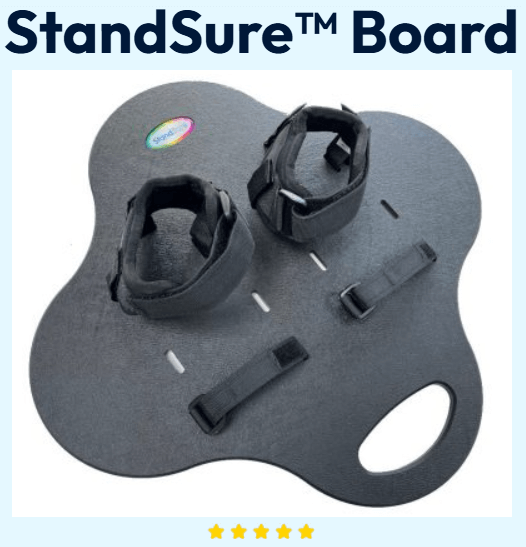
Standing treatments are a good complement to FES because they help you stay steady when you are standing. For example, people who have had a stroke or have cerebral palsy can use the StandSure device with FES to keep their feet in the right place and balance. StandSure keeps the feet steady when moving from sitting to standing, which lets patients focus on the muscle contractions that FES causes. This combination enables individuals to maintain a straight posture, develop muscle, and experience increased confidence under observation.
Robotic-assisted rehabilitation, brain-computer interfaces, and even soft robotics are all new technologies that are being used to create hybrid systems that provide more personalised care.
FES has a bright future because new developments are coming that will make it easier to use and more effective. People can control stimulation with their thoughts when they use brain-computer interfaces (BCIs). This speeds up the recovery of stroke victims’ upper limbs. Soft robotics and functional electrical stimulation (FES) could work together to make gloves or costumes that people can wear to help them get their hands back.
Technology that can be implanted and made smaller is getting better. For instance, small high-voltage devices are making things smaller and easier for people to use. Modular neuroprostheses for hybrid FES-robot applications enable customised rehabilitation programs.
Research on home-based toolkits, like FES cycling for SCI, aims to provide patients more freedom outside of medical settings. Advanced sensors and AI-driven changes will make stimulation as effective as possible while lowering side effects and boosting neuroplasticity.
Market forecasts include growth, driven by an ageing population and more neurological diseases, with a focus on low costs and global availability.
Functional electrical stimulation is a good thing in neurorehabilitation because it helps people move and be free again. FES has been used to treat many different diseases for a long time. It can help with physical health, mental health, and social involvement. There are risks, but using it carefully makes it safe. When used with tools like standing assistance, it shows that therapy should be done in a whole-person way.
As research moves FES forward, we can expect to see even more new ideas that will make this technology easier to use and more useful. FES is more than just a way to help people who have trouble moving around; it’s also a way for them to get their energy and independence back.

Book a personalised demonstration of the StandSure™ today by filling out our request form. Have any questions? Call us now, and our team will be happy to assist!


